PATIENT TECHNIQUE
TEACH TO GOAL
INTRODUCTION

In previous modules, we discussed that poor inhalation technique is very frequent. Of major concern are critical inhalation errors that compromise treatment effect and health outcomes. Suboptimal inhalation technique may also lead to insufficient adherence to medication and increase the risk that physicians resort to prescribing excessive doses.1

Adding to the complexity is the large amount of different inhalation devices that all have specific requirements to achieve optimal effect.2

However, even with accurate device selection adjusted to the patient's phenotype, many patients fail to operate their inhalers correctly.1

A strong correlation was seen between inhaler misuse and older age, lower schooling and the absence of instruction from healthcare professionals.

The latter was the only modifiable factor.4

This underlines the need for careful instruction of inhalation technique and continued vigilance.

In this module, we approach the following questions:

  • What is the best teaching method?
  • How many instructions are required?
HOW TO IMPROVE INHALATION TECHNIQUE?3
  1. Improve device selection
    (patient phenotype, shared decision-making)

  2. Educate and re-educate
    (face-to-face, multimedia, training devices)

  3. Benefit from technological advances
    (new inhalers, feedback devices, web-based materials)
!
Different inhalation devices all have specific requirements to achieve optimal effect
Device-specific requirements2
Patient-specific requirements3
Inhalation flow rate
Flow acceleration
Inhalation volume
Inspiration time
Physical skills
Dexterity
Hand strength
Lung capacity
Hand-lung coordination
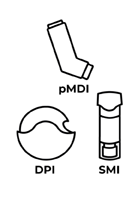
pMDI: pressurized Metered Dose Inhaler | DPI: Dry Powder Inhaler | SMI: soft mist inhaler
EFFECTIVE TRAINING TECHNIQUES

A comparison of printed information, video presentation and a direct counselling session (72 participants) showed that direct instruction was by far the most effective technique to train proper inhaler technique.5

Percentage of patients demonstrating inhaler technique competency after instruction
17% CDC Video
11% YouTube
17% Pamphlet
72% Pharmacist Instruction
*p < 0.0001 vs. combined and p ≤ 0.05 vs. individual interventions
Figure adapted from Axtell et al., 20175

Earlier, Bosnic-Anticevich, et al. had already shown that the addition of a physical demonstration in the community pharmacy resulted in significant improvements of inhaler technique up to 16 weeks, compared to standard instruction of written and verbal instruction alone (p<0.05).6

CONCLUSION

This module emphasized the importance of thorough training in inhaler technique. Takaku demonstrated that after initial guidance, instructions had to be repeated at least three times to achieve effective inhalation skills, in both asthma and COPD patients.1 All healthcare professionals need to stay vigilant on patients' skills decay and consider inhaler training as a repetitive, ongoing process.12,13

Several approaches can help to successfully improve inhalation technique, and if needed, change of device is required.

  • Review of the technique
  • Repeated instruction
  • Teach back capabilities
  • Adapted personal information: leaflets, apps, videos
  • Involving partners, relatives
  • Electronic support (e-devices)